Pictures and Facts About Bengal Cats and Kittens
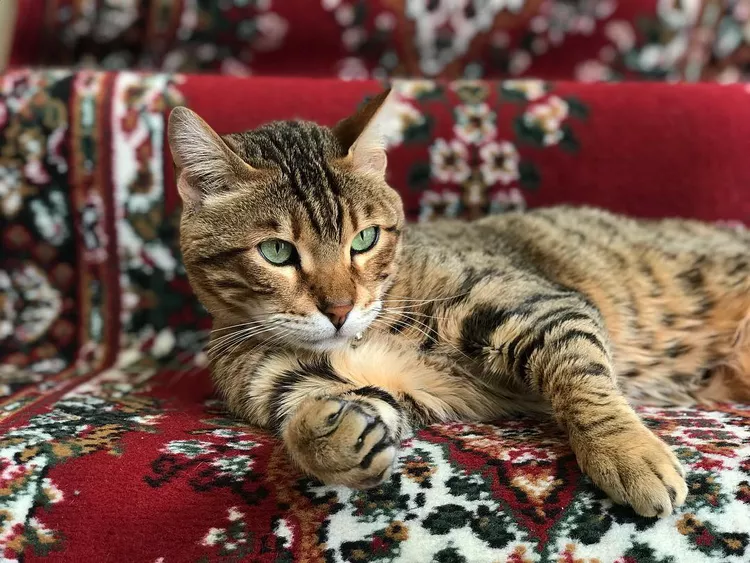
Bengal cats have the look of their wild relatives, but the size and personality of a domestic kitty. Plus, they're cute, and unlike larger, exotic cats, they can be kept in your house safely.
Bengal cats are hybrids of domestic cats and Asian leopard cats. Ownership of early-generation hybrids may be restricted in your state as exotic cats. Registered Bengal cats are at least four generations removed from their wild ancestors. Most areas will allow hybrids of the fifth generation and beyond, but you should always check your local laws before introducing one into your home.
Whether you're already a Bengal cat parent or are considering purchasing one, learn some fascinating facts (and see super-cute photos) about this domesticated but wild-looking kitty.
- 01 of 07
Bengal Cats Have an Interesting Origin Story
Given their wild ancestry, Bengal cats haven't been around all that long—and they originated in America.
In the 1960s and 70s, a pediatrician named Dr. Willard Centerwall began breeding Asian leopard cats with domestic cats to study their genetics. According to his work, they were immune to the feline leukemia virus; he hoped this research could eventually be applied to humans with compromised immune systems.
Centerwall became critically ill and gave his hybrid kitties to Jean Sudgen Mill. She had experimented with cross-breeding exotic cats and domestic cats in the early 1960s but took a break from breeding when her husband passed away.
After receiving Centerwall's hybrids, Mill continued to mate the cats and promote the newly developed breed. She originally called the cats the "leopardette," but their name was changed to Bengal in honor of the scientific name of the Asian leopard cat, Prionailurus bengalensis.
After years of work, Mill successfully had the Bengal recognized by The International Cat Association in 1983.
Continue to 2 of 7 below - 02 of 07
Bengal Cats Are Known for Their Distinct Appearance
Bengals are perhaps best known for their appearance—they look like tiny jungle cats, after all.
Bengals' coats are short and silky, and have an iridescent effect; if the light catches a Bengal cat's coat the right way, it can look glittery.
The most recognizable characteristic is likely their striking, distinct markings. Generally, their coats can be spotted (like a cheetah) or marbled with long, slightly wiggly stripes as seen in marble stone. Most Bengals are black and brown, but their coats can have a variety of colors, including silver, charcoal, and even blue.
Continue to 3 of 7 below - 03 of 07
Bengal Cats Are Very Active
Although most of the wildcat has been bred out of Bengals, owners say their cats are extremely active, vocal, and highly intelligent. If you're looking for a kitty who just wants to curl up and chill in a sunny spot, then a Bengal cat probably isn't for you.
Continue to 4 of 7 below - 04 of 07
Bengals Can Be Large
While a Bengal cat won't weigh as much as a Maine Coon, they can get pretty big. A male Bengal cat can weigh between 10 and 15 pounds on average, while females weigh between 8 and 10 pounds.
There are some exceptions: Larger male Bengals may weigh as much as 20 to 22 pounds.
Continue to 5 of 7 below - 05 of 07
Bengal Cats Have a Predatory Instinct
Bengal cats have an extremely strong predatory instinct, so it's important to keep bunnies, hamsters, mice, and other small pets away from them.
If you're squeamish—or just don't want to wake up to the occasional dead mouse or bird—a Bengal may not be the right kitty for you.
Continue to 6 of 7 below - 06 of 07
Bengal Cats Can Be Extremely Expensive
If you want to purchase a Bengal cat, you better start counting your pennies now—they can cost some serious cash.
If you're looking for a non-show Bengal cat, you'll likely pay a few hundred dollars. But if you're hoping for a show-quality Bengal, the price tag can be in the thousands. The Bengal Cat Club notes that prices depend on the location, the breeder, gender, quality, and generation removed from the Asian leopard cat. They note $10,000 as one of the highest prices, and there are reports of a British woman paying $50,000 for a Bengal cat.
Continue to 7 of 7 below - 07 of 07
Bengals Create a Spin-Off Breed Called the Cheetoh
Cheetohs, a combination of Bengal and Ocicat, also originated in the United States in 2001. They were originally bred by a woman named Carol Drymon, who wanted to develop a unique pedigree—and she accomplished her goal.
The Cheetoh looks like a tiny cheetah but has the size, personality, and temperament of a domestic cat.
-
How much is a Bengal cat?
Depending on your location, a Bengal kitten costs between $1,500 to $3,000.
-
How can you tell if your cat is a Bengal mix?
There are a number of ways to determine if your cat is a Bengal mix, aside from genetic testing. First, check your cat's coat colors and markings: Do they have spots or rosettes? Are their bellies spotted? Is there no white fur on their body anywhere? Do the tips of their fur have an almost shimmery appearance? All of these are signs of a Bengal. Next, look at your cat's physique: Is it muscular and lean? Not overweight? Is its body long with a small head? Finally, how does your cat behave? Is it vocal? Does it chirp? Have a high level of energy? These are all traits of Bengals.
-
How long does a Bengal cat live?
Bengal cats live from 12 to 16 years old.